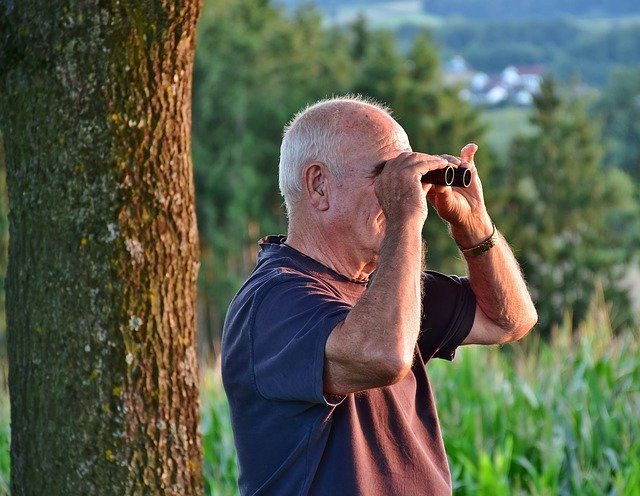
Birding Binoculars Background
Nothing I hate more than to hear birders getting all excited about the first pair of birding binoculars they’ve bought. They “did the research” and found the best pair were an astronomy-grade, double barreled telescope! Why? Because that would allow them to see birds in another county without ever going outside.
How crushed they are when they realize they’ve spent some serious money on a pair of binoculars that are of no use to them at all. Does this sound like anybody you know?
Simple Truth About Birding Binoculars
The first thing we need to get straight is that birders have much different requirements for binoculars than hunters, fisherman or sport enthusiasts.
What do we mean by this? The birder needs binoculars that are able to see in low light and be able to spot birds easily. Then, they need to be able to focus quickly and have a wide enough field of view to help spot new birds as they appear. They need true color viewing, no field distortion and be fog-proof. They should work well with or without glasses.
Beyond that, birding binoculars must be light to carry and use with a neck strap. They should be light enough to grasp comfortably and the view should be easy on the eyes for long periods. Birders usually want them compact enough to for a rucksack. An adapter for a mono or tripod would be great too. Finally, rugged construction is a must for wilderness viewing.
Let’s look at the BIG specs that help accomplish these goals.
Magnification And Objective Lens Diameter
Two numbers define the basic specifications for binoculars. The first number is the magnification factor. For instance an 8x binocular magnifies an image 8 times. Higher magnification makes it difficult to keep the bird in view and also the field of view will be smaller. For birding, an 8x binocular is the most commonly used magnification. Just remember the higher the magnification the higher the distortion from moving the binoculars.
The second number gives the diameter of the objective lens. The larger the diameter is the more light is captured by the binocular. This makes the resulting image clearer and brighter. The larger diameter also makes a larger field of view. So, in the birding world, the most popular objectives are 40mm and 42mm. Going beyond 42mm makes the binocular a little too heavy and cumbersome. Under 30mm will be really easy to carry but lack the detail in low light.
Lens And Prism Quality
Lens and prism quality and the optical coatings are also important. Coatings reduce loss of light through reflection and help to preserve clarity and true color throughput. Fully-Multi-Coated (FMC) coatings are best for bird watching. Eye relief refers to the distance from the eyepiece to the eye. Those who wear glasses need more eye relief for the extra distance between the binocular and their eye caused by their glasses. If your pair are not built to compensate for this you’ll lose field of view.
Roof and Porro Prism designs are the two body styles of binoculars. Roof prism types are more compact and modern looking. Their objective lenses are more in line with the eyepieces. However, porro prism types are more the traditional style with lenses stepped out from the line of the eyepieces. Birding enthusiasts are now choosing the roof prism type because the quality has caught up with porro types in recent years.
Other Considerations
Your new pair of birding binoculars should be easy to focus with a single focusing knob. Any binoculars with separate focusing knobs will be too slow to be useful.
They should have a diopter adjustment that allows you to adjust for the vision difference between your eyes. Your eyes rarely have the same abilities. Having mis-matched viewing barrels will make them very hard to use. Plus, you’re likely to end up with a whopping headache! You also need to be able to adjust the barrels for the distance between your eyes. NEVER buy a fixed pair because they rarely match your individual eye distance.
If you can’t go to a store to try them make sure the online merchant you use has a generous return policy. Then, you don’t need to be afraid to buy a few at once looking for the right pair.
Birding Binoculars That We Recommend
Click the pics below.
Low Price Range (under $200.00 US)

Mid Price Range ($100.00 – $500.00 US)

High Price Range ($500.00 – $1000.00 US)

Top of the Line Price Range (over $1000.00 US)


Leave a Reply